
A Selfless Saint
the little ways we become holy

“Well, wearing Nike sneakers and making a website isn’t enough to make you a saint”
Such was the criticism of an overly online Catholic trad bro who claimed to not like St. Carlo Acutis.
I tried my best to explain to him that it wasn’t Carlo’s website that got him to heaven, but the subject matter on the website and his deep love of and devotion to the Eucharist, which carried him through his dying days.
But, nuance on Twitter is rare, the trad bro was not convinced, and while I deeply believe St. Carlo is working on that man’s heart from heaven, it does reveal a deeper question we all seem to ask today:
What makes a Saint?
Why are they saintly? What did they do that I can look at and maybe emulate myself? How’d they really earn that spot in heaven? Because that’s what at the heart of the question: what did they do then that I can do now, and maybe get to heaven too?
I can’t necessarily code a website with info on Eucharistic miracles. I can’t volunteer to die in a concentration camp. I can’t found a religious order or recount visions of Mary or lead the Church or…
Or maybe we can?
We seem to look for the big thing the Saint did because that’s an easier story to tell. Much more exciting to recount the huge sacrifice, the major choice, the big drama of a moment. But maybe the answer doesn’t lie within the big moment alone.
Maybe what makes a Saint is the tiny, hidden moments of selfless love, repeated over and over, so that when a big moment of trial, suffering, or tribulation unfolds, we can choose God first, and above everything else. We can choose God, and love of Him, and love of others, before considering ourselves.
The big thing happens because of all the little things that came first.
I think that’s why St. Maria Goretti is a saint. She chose God, and His mercy, over everything else.
Maria was poor. Born poor, stayed poor, died poor. She had no wealth, no prestige, no creature comforts or prized possessions.
Her family lost their land and home, moved into a duplex, and when her father died, Maria stayed home to raise her younger siblings while her mother and older brothers worked fields to earn what little they could to survive.
In that extreme poverty, with very little and even fewer prospects for her future, Maria clung to hope. Maybe a better life was possible, someday, but for now this is where she was, this is what she had, and she’d make the best of it.
Her siblings would say later that Maria was always making music of some sort — humming, whistling, singing quietly. As she cared for her baby sister, as she helped cook what little food the family had and clean the tiny apartment they were crammed into, Maria did not doubt God’s providence and provision. With very little, she found a way to praise God for what she knew could be enough.
Her joy was contagious, her optimism a singular source of happiness for her family, her faith a comfort to her siblings, and when she was assaulted and attacked, people could hardly believe that her bright light was taken in such a violent and horrific way.
Rushed to the hospital after being stabbed over 14 times by her assailant, as she was in surgery, Maria thanked the doctor for operating on her and asked about her mother. As she lay dying the next day, Maria forgave her attacker. It was revealed later that he’d harrassed and assaulted her at least twice before, and she’d been scared to tell anyone for fear of death, or scared her family would lose their home.
In her suffering, in the midst of being attacked and on her deathbed, Maria thought not of herself. She considered others — their salvation, their grief, and their own journey to Jesus. For eleven years she’d been selfless, and in the final moments of her short life, she still was.
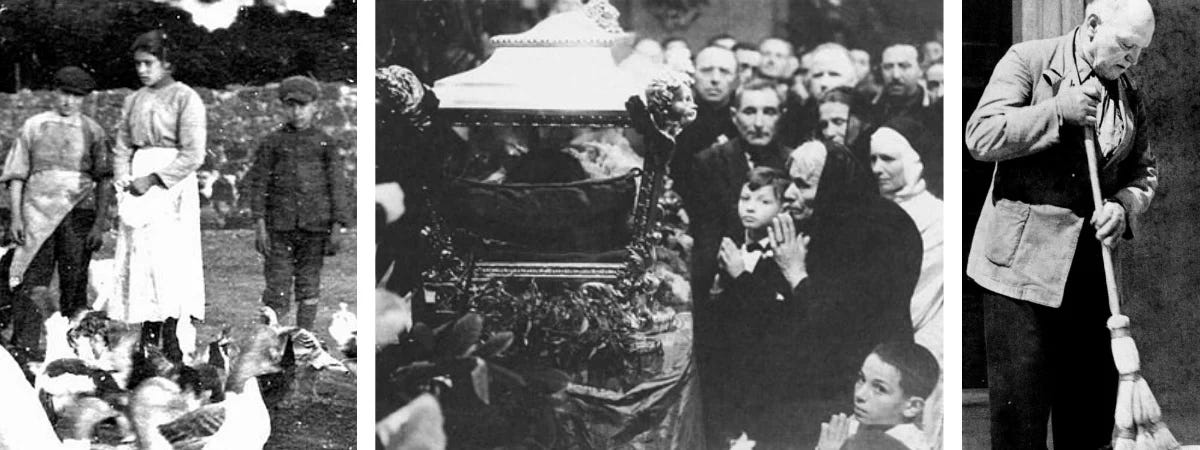
That’s what makes a saint. The selfless love poured out every day.
Maria Goretti is not just a saint because she forgave her murderer or fought off his advances. Those are heroically virtuous things she did, in that big moment. But, she is a saint because she learned how to forgive in the little moments of mercy practiced in her home. She’s a saint because she knew she was going to be with Jesus, the Lord she loved because she went to Mass and received the Eucharist as often as she could. She’s a saint because she was grateful, the virtue of gratitude learned with even the very little she had to herself. She’s a saint because she considered the lives, faith, and love of others, knowing that one’s life is truly lived to the full when in service to others.
St. Maria Goretti is not a saint just because she fought off her assailant, no more than St. Carlo is a saint just because he coded a cool website about miracles. She is a saint because she loved Jesus, and knew Jesus, and allowed her whole life to be transformed by that love of the Lord, compelling her to forgive the man who ended her life in the same way Jesus forgave those who would crucify Him from the Cross.
Why is she a saint? Why is anyone a saint?
Not just because of the singular big thing that’s told in a story. She’s a saint, we can be saints, because of the love of Jesus, learned, lived, and shared, little by little, every day.
Help with the Beatification of Fulton J. Sheen
We need 75,000 World Mission Rosaries, and you can help make them. Details here:
The Dicastery for the Causes of Saints at the Vatican verifies the holiness of individuals who are canonized as saints. Here is a link to it https://www.vatican.va/content/romancuria/en/dicasteri/dicastero-cause-santi/profilo.html There are over 10,000 saints in the communion of saints, and there are many different acts that qualified them at the different stages to sainthood. The most important element is the verified miracles attributed to intercessory prayers to venerable and blessed holy men and women.