

Magnifica Humanitas has arrived, and it is beautiful.
It is well worth reading in full, because it is a wonderfully written, deeply thoughtful, clearly prayed through text that I think will stand the test of time. Leo’s first encyclical shows us his heart, and invites us to consider what is happening in this current age and how each of us is uniquely grand, dignified, valuable, and loved.
I’ll be on CNN throughout the day, and also here at 9 a.m. CT to explore the document with my friends from PushPay and the Faith & AI project.
As you read Magnifica Humanitas, perhaps even listen to Beethoven’s 9th Symphony. You’ll see why, I promise.
Magnifica Humanitas is not a screed against AI, nor it is a full throated endorsement of the technological advancements of the AI tools surrounding us. It is a consideration of the moments we face, how history got us here, how the social doctrine of the Church can guide us, and the responsibilities we each have in the current age of Artificial Intelligence.
That, I found, to be quite compelling. We all play a role in this grand story of creation, we are each a builder/architect, and our dignity cannot be undersold or forgotten. We are grand. And because of that, we are each called to safeguard one another and it is the Church’s teachings that must guide us.
Now, this is my summary of the encyclical, after having read Magnifica Humanitas a few times over the weekend thanks to my embargoed copy. I of course read it slowly at first, then with a highlighter, and then again with a notebook. I have a feeling I’ll read it a few more times, because the document is long, heavy, and detailed. In comparison to some other “first encyclicals” of the last few Popes, Leo is lengthy, and so many will summarize it to help make it accessible, but I cannot say this enough: read it for yourself. We’ll have hot-takes and reactions and deep dives galore across Al Gore’s Internet, and I’m grateful so many are engaging with an encyclical in the first place. But, always read the stuff of the Church for yourself. Always.
It’s of course free to read on the Vatican website, and you can add a physical copy to your library! Ignatius Press is printing a lovely copy worth a spot on your bookshelf:
Now, to the details:
The much anticipated first encyclical of Pope Leo (currently going viral for having embraced the 6-7 meme) was presented at the Holy See this morning.
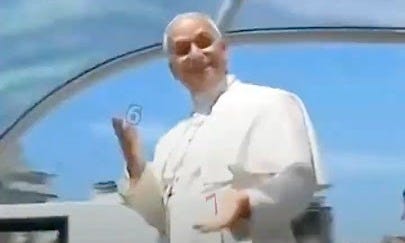
I’ll have more to say about the press conference that includes the Holy Father and his close collaborators alongside Anthropic’s co-founder (which is still on-going at this moment). No one remembers a Pope going to his own encyclical’s “launch” before, and there was a launch video that showed the great golden thread through the papacies of Leo XIII to today.
Leo was smiling ear to ear throughout this video, and with his historic attendance at the encyclical’s launch press conference, my bleary-eyed early morning self is grinning watching his pride as he shares with the world his letter of love and challenge. This is a Shepherd, walking through the pasture, bringing us sheep along. Here is a Father, speaking to his children. Here is a pastor, instructing his people. More on the presser when the espresso has done its job in full.
For now, here are 10 important themes/points from Magnifica Humanitas as you sit down to read it.
Magnifica Humanitas is magnificent, painting a picture of the grandeur of God writ large in the world, seen and experienced fully within His creation (namely us humans) and when we encounter the face of the Son of God, Jesus Christ. Pope Leo makes clear that we grand and magnificent humans face a pivotal choice: will we build Babel or will we construct a city of God? As we face that choice, where do we turn? Within the first few lines, Pope Leo quotes from Gaudium et Spes, the document of the Second Vatican Council that he has yet to tackle in his Wednesday audience catechesis on Vatican II.
“Whenever humanity is in danger of marring its true identity, we Christians lift our eyes to the Incarnate God, knowing that it is ‘only in the mystery of the Word made flesh that the mystery of humanity truly becomes clear.’” (MH, 1)
The encyclical is long. 245 paragraphs, to be precise. (You’ll see some saying “it’s X number of pages” but pagination on an encyclical is entirely dictated by the printing from various publishers and thus will vary widely). Encyclicals are measured in paragraphs/sections, not page numbers, and this one is quite long. Leo has lots to say, and he tackles it over 5 chapters, with over 240 footnotes and references drawing from the vast Tradition of the Church.
The social doctrine of the Church is a rich and deep well. Pope Leo traces its historical development, the ways it has been taught, interpreted, and implemented in the Church and world, and challenges us to consider that the teachings of the Church concerning the principles of common good, universal destination of goods, subsidarity, solidarity, and social justice are more than nice ideas. These are ever-present realities we must embrace, live, fight for, and proclaim boldly, especially as people of Faith. For many who come to this document expecting a screed against or wide support of Artificial Intelligence and technological advancements, they will be first met with a walk through the robust teaching of the Church that captures the dignity of all human beings.
“…social justice is a concrete way of following Jesus and being faithful to his Gospel.” (MH, 77)
The world in which we live is rapidly changing, and Pope Leo is calling us to ask one key question about what is unfolding: What are we building?
“This is the blessing we implore from God and the task before us: to be builders of communion, not architects of Babel; servants of the coming Kingdom, not owners of towers destined to collapse.” (MH, 16)
Leo poses a few key questions worth considering:
“Where are we going? Toward what goal do we wish to orient ourselves? What direction should we choose as people and as a human community?” (MH, 6).
And to guide us through these questions, he offers two scenarios/characters: the buildling of the Tower of Babel and the Rebuilding of the Walls of Jerusalem. I’d recommend going and praying with these passages of Scripture, from Genesis 11 and the Book of Nehemiah.
“With the heart of a shepherd and a father, I ask everyone to abandon the construction of yet another Tower of Babel and to join forces in building up the common good, so that humanity will never lose its beauty, and the world once again will come to recognize the human heart as the place where God desire to dwell.” (MH, 16).
Humanity will always be greater than anything humans make, and while AI is a valuable tool, it is just that: a tool. AI is created and manmade, and therefore under our control. We must fashion the use of AI around guiding principles and an ethical, moral code, because technology is far from morally neutral. Throughout Chapter 3, Pope Leo explores the creation and use of AI and shows a mastery of the topic, indicating that he spoke extensively to those who have written the code and come up with the ideas that feed the “mind of the machine” and thus influence humanity. If Artificial Intelligence is set to try and build a new kind of conscience, a new kind of human, then this shows us the very real human desire for more, and that can ultimately only be satisfied in a relationship with Christ. This is key: Pope Leo does not spend his time in this encyclical just telling the world how to use or not use AI. Instead, he, as the shepherd and Father we need, points us back to Jesus. That is the only lense through which we can tackle any changes in the world, technological or otherwise. Humanity is magnificent because of the most magnificent human, Jesus, and we transcend ourselves in relationship with Him, through grace.
Pope Leo would probably get rid of your school’s Chromebook and the AI chatbots we talk to, including the Catholic ones... Maybe that’s just my read, since I’m on a rage-against-the-ed-tech-machine, but I cheered when I read the entire section on education and the central role of schools in Chapter 4. This is the line that should be blasted to every educator, administrator, and parent this summer:
“Schools are not called to follow the pace of the digital world, but to offer that which the digital sphere by itself cannot provide, namely a shared time for learning and developing trustworthy relationships.” (MH, 147)
AI risks automating the human spirit, and as such, we have to ensure that AI and technological advancements are tools for us. We cannot become cogs in a machine that are simply productive and efficient. Our dignity, and the dignity of our work, is paramount, and it comes not from what we do, but simply because we are. That which is artificially intelligence cannot and must not replace that which is real and wise.
Peace is not merely an idea, or even just an ideal. It is a craft, and an unarmed and disarming peace is of the utmost importance in the world today. Leo extensively explores and calls out the military industrial complex, the ways in which AI and technology create a divided world that can lead to quick war, forever war, and a belief that holds (wrongly) that peace is just far too difficult to achieve. War is easy. Peace takes time, and Pope Leo asks us to work to create peace within so that peace can reign throughout.
Humans long for more. We would not have transhumanism, post-humanist, or even AI driven movements and advancement if there was not a desire within the human heart for more. We are restless, after all, and our Augustinian Pope quotes St. Augustine to remind us the restless heart only comes to a satisfied stillness in the Lord. Some in this world falsely believe we can build the more, invent the more, and code the more. But no! That more for which we long can only be found in God.
“…as a believer among believers, I invite everyone to contemplate, in the face of the Son of God, the grandeur of humanity that shines a light also on the era of AI…No computational system, however sophisticated, can create a heart that gives itself, or a conscience that discerns good from evil. Even when machines excel in efficiency, a human face that asks to be gazed upon remains the center of our history.” (MH, 233).
We are not without hope in the age of AI. In fact, we should never be without hope when facing change. Because it is precisely in the face of change that God shows the strength of his arm, and the scattering of the proud, as he casts down the mighty, lifts up the lowly, fills the hungry with good things, and sends the rich away empty-handed. This is what Mary proclaims, what she prays, when faced with a challenge and a wild change in her life. She “bursts into a hymn of praise and joy. Her soul magnifies the Lord and her spirit rejoices in God her Savior, because he chose a young, poor, and humble girl for his plan of salvation.” (MH 243). In the age of AI, we must do the same. Just like Mary, we can see God’s invisible work in history and among mankind and ultimately direct our gaze to His Face.
Some will love Magnifica Humanitas. Others will say it doesn’t go far enough in either condemning or endorsing the technologies that surround us. Still others will claim its too long, trying to do too many things in one document.
But I say sincerely, I hope and pray we receive this encyclical as Pope Leo seems intent to give it: as the shepherd and father he is, reaching out to and appealing to men and women of faith, men and women of good will, the tangentially curious, the wildly antagonistic, and everyone in between.
I’d bet that this will be one of the most widely read encyclicals of all time, not just because it’ll be summarized in the very same AI machines that Leo writes about within it, but because in this digital age where we race along the information highway that is the internet, Pope Leo stands alongside us, not just beyond us. He does not write as someone removed from or outside of this digital environment in which we all live. He too has a phone, he too has seen the world wide web, and he put pen to paper to remind us who we are as we swim in the ocean of the digital age.

In the end this is the question posed: What ultimately safeguards humanity? In short: a civilization of love, which we build in relationship with God and others. What protects us in an age of AI? Remembering it is a tool that we use, not a tool that uses us. What brings us hope in this rapidly changing era? The face of Jesus Christ, the fuel that is the Eucharist, and communion with one another.
And now, for one little fun fact and 11th bonus point.
Pope Leo is clearly a Lord of the Rings fan.
Jump to paragraph 213 and you’ll see why. Gandalf is now part of the Ordinary Magisterium of the Church!
Which yes, this means I’m even more profoundly proud of my “the Pope is never late or early” joke last week as some ill-informed influencers claimed Magnifica Humanitas was delayed (it wasn’t) when we didn’t get it on May 15.
Magnifica Humanitas has arrived precisely when Leo intended it to: on May 25, the day after Pentecost, at the start of Ordinary Time in this year, encouraging us to flourish, to thrive, to avoid the Babel Syndrome and instead choose the way of Nehemiah to build a civilization of love. What could be more ordinary than humans embracing what makes them extraordinary: their dignity? That’s an adventure indeed.

And that starts with all of us. We must go on that adventure. We are the ones, loved into our existence, who must decide what to do with the time given to us.
Pope Leo invites us to do with that time what we dignified, free, loved, creative, magnificent humans alone can do: build the civilization of love.
“The civiliation of love will not arise from a single or spectacular gesture, but from the sum total of small and steadfast acts of fidelity that serve as a bulwark against dehumanization…it is worthwhile pausing to reflect on some aspects of how we, each in our own way, can cooperate in building the civilization of love.” (MH, 213).
My first analysis on CNN earlier this morning.
Katie, you are persuasive! This seems like the kind of document that is to be savoured slowly, so I will be ordering a hardcopy – and proposing a book club for my Secular Franciscan fraternity in the fall. I want to break out of the Amazon complex, though, so I will be ordering from the publisher lol
I was up early listening to its presentation on EWTN. I’ve already recommended it to my young adult children, one of whom is a recent Computer Science graduate disheartened by her inability to secure a job in the age of AI. Looking forward to reading it today and your summary.